

‘Gunla Parva,’ a significant cultural festival for Buddhists, is celebrated for a full month—spanning from the first day of the bright fortnight of Shrawan to the first day of the bright fortnight of Bhadra (or, according to the Nepal Sambat calendar, from Gunla Thwa Paru to Nhyala Thwa Paru).
Gunla Month is the tenth month following the Ninth (9th) Month of Nepal Sambat. Buddhists adore and honor Lord Buddha in monasteries, chaityas, and shrines during this Gunla Month. The Nepali word “Gunla” is a combination of the words “Gun” and “La.” “La” means month, and “gun” means Ninth. King Bikram Dev initiated this Gunla festival (गुंला पर्व).
One of the most important religious and cultural celebrations for the Newar Buddhist community in Bhaktapur is Gunlā Parva (Gunlā), which reflects the city’s rich spiritual legacy and long-standing customs. The festival is devoted to the worship of the Buddha, the practice of compassion, and the acquisition of religious merit. It is observed during the sacred month of Gunlā in the Nepal Sambat calendar, which often falls in July or August. Gunlā Parva is intricately linked to the everyday existence and cultural identity of the Newar population in Bhaktapur, where age-old traditions are meticulously conserved and transmitted down the generations.
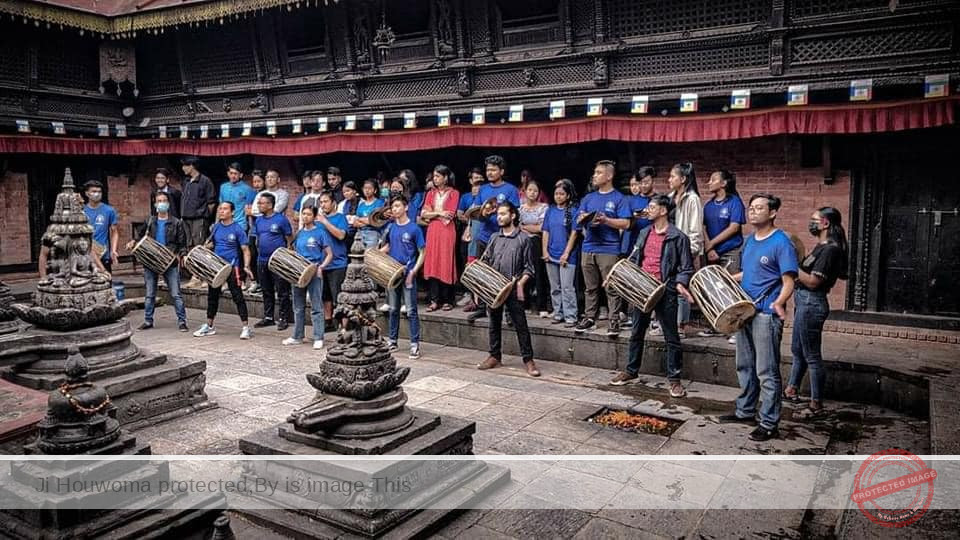
Devotees travel to monasteries, temples, and hallowed courtyards during this auspicious month to make religious sacrifices, light butter lamps, and give prayers. The Gunlā Bājan, a traditional ensemble of devotional music played on drums, trumpets, cymbals, and flutes, is one of the festival’s most notable features. They accompany early morning processions through Bhaktapur‘s old streets. The community’s devotion to Buddhist teachings is symbolized by the melodic sounds that foster a spiritual ambiance. Families foster social cohesion and cultural continuity through collective worship, scripture recital, and charitable deeds.

As historic Bahas, Bhahis, and temples transform into thriving hubs of religious activity, the festival also showcases Bhaktapur‘s distinctive artistic and architectural legacy. Gunlā Parva exemplifies the lasting influence of Newar Buddhist culture in Bhaktapur by showcasing a peaceful fusion of faith, music, art, and community involvement. Beyond its religious significance, the festival is a live cultural institution that draws tourists and academics interested in Nepal‘s intangible cultural legacy while fostering a sense of communal identity and respect for ancient traditions. Gunlā Parva, one of Bhaktapur‘s most beloved cultural celebrations, continues to uphold the city’s historical customs and foster the spiritual and cultural diversity that characterizes the distinct identity of the ancient Newar town.
In Nepal Mandala (नेपाल मण्डल), there used to be a forest. “Nagdaha” was its name. Vipassana Buddha arrived in this woodland and planted lotus blossom seeds. It was a very lovely and unusual lotus blossom that grew in the center of this jungle. This lotus blossom was radiating a magnificent brightness. Crowds of people would be drawn to this scene. This was Swayambhunath’s supernatural ability; he was created during the Treta Yuga (the second of the four yugas (ages) in a cycle, following Krita (Satya) Yuga and preceding Dwapara Yuga). Following the arrival of the Tathagata, Mahamanjushri traveled from Lhasa, Tibet, to Nepal via tunnel with roughly 5,000 of his pupils.

From there, he and his two wives, Varada (Kesini) and Mokshada (Upakesini), traveled to what is now Chobhar. He chopped the Chobhar hill with his Chandrahans Khadga (a big sharp sword), releasing all the water. The Lotus blossom gradually made its way west and established in what is now Swayambhu.
Swayambhu is hence the original land of Nepal Mandala. Swayambhu, which translates to “land that was created by itself,” is a combination of the words “Swayam” and “Bhu.” A man by the name of Dharmakara became the first monarch of the realm so formed, which was named Manjupatan.He thus began his “Dhamma” religion at Jyotirup Swayambhu in Manjupatan. “Chaitya Sewa” is the name of that. Gunla Dharma is the name of this Chaitya Sewa.

The four Buddha Bhoomi (Nama Buddha, Vajrayogini, Swayambhu, and Rato Machhindranath) are visited on the fourth Wednesday of the month to acknowledge the four Buddhas. During the Gunla Parva, people in Bhaktapur‘s Seventeen(17) Monasteries pray for a month while playing the Gunla instrument.

During the Gunla Parva in Bhaktapur City and other Buddhist temples playing Gunla Bajan Hymns, devotees bathe early in the morning, wash themselves with traditional instruments, recite Hymns, and circumambulate the Bahal, Chiba, Bihar, Chaitya, and Gumba while chanting mantras. The musical groups are representative of the city’s several neighborhoods. In their homes and in hallowed courtyards, the faithful recite the texts. Some people fast. Dyo Thāyegu (द्यः थायेगु) is another devotional activity that takes place during Gunla, where devotees use a mold to create small stupas out of black clay.

This monsoon is known as Gunla Jhari because it rains during this month.