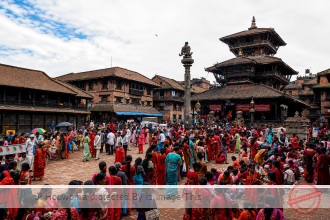


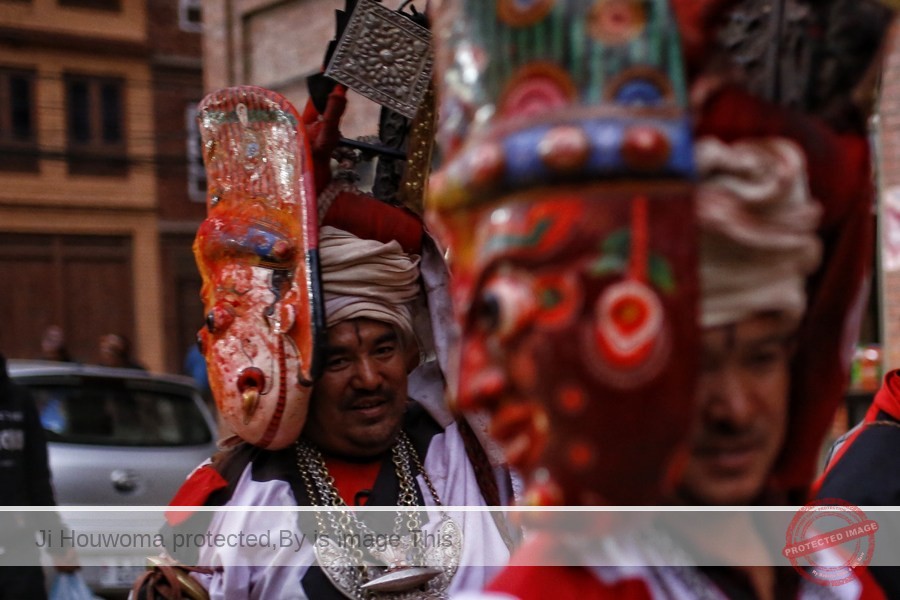
The history of the Navadurga Naach tradition is not well known in Bhaktapur. Many of the devotees are familiar with the Navadurga, their processions through Bhaktapur’s streets, and their use of dance and masks. The Navadurga community and residents who have pursued education on the subject are the only people who are familiar with the history of the custom.
The Jwala forest, northeast of Bhaktapur, was home to the Navadurga. The Navadurga would catch people as they went by, murder them, and then consume their blood as a self-sacrifice. One day, Sunanda, a Āchāju (Holy Priest of peasant descent), was taken prisoner by the Navadurga. In contrast to the majority of Ācāju, Sunanda was an adept in Tantric knowledge and Mantras, which are sacred utterances. Using a mantra, he was able to bind the Navadurga and limit their mobility. The Navadurga, embarrassed, begged Sunanda to pardon them so they wouldn’t sacrifice him.Instead of letting them go, Sunanda shrank them, put them in his basket, and carried them back to his Bhaktapur house, where they were kept in a chest and occasionally worshipped.
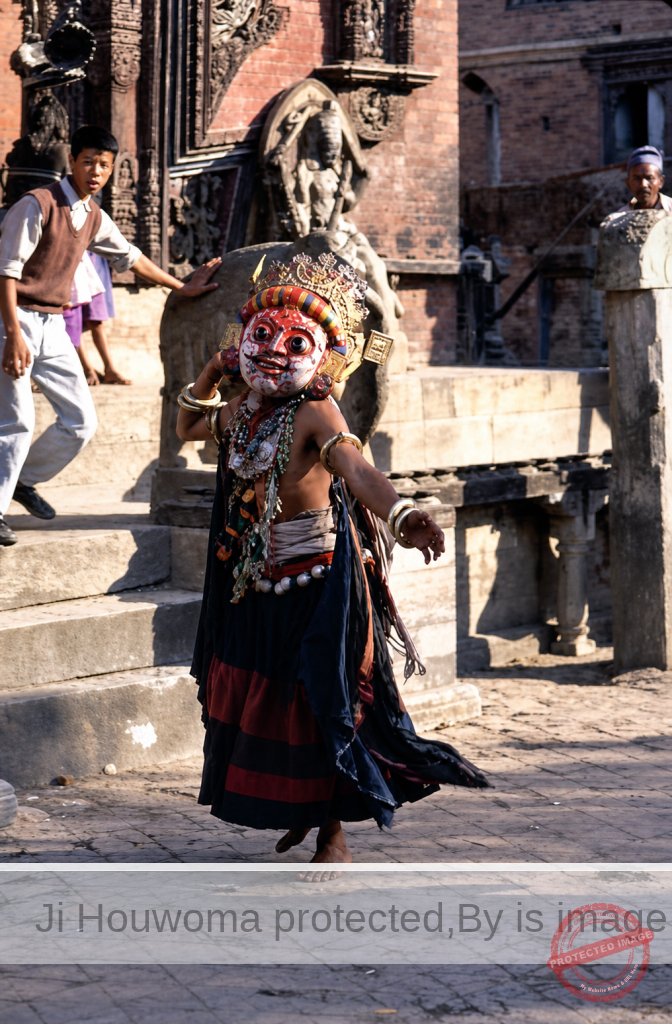
After a certain amount of time, Sunanda‘s guru, Somarā Rājopādhyāya, a Newa Brahmin, paid him a visit. With a profound and complex knowledge of Tantra, Somarā Rājopādhyāya had informed Sunanda that he had been improperly worshiping the Navadurga. Consequently, Somarā Rājopādhyāya returned to his own home in the Palisāche neighborhood with the chest containing the Nine Durgās, where he concealed them. Using Tantric Bidyā (Hidden Arts-Rituals), Somarā Rājopādhyāya secretly worshipped the Navadurga and offered sacrifices to them.The Navadurga were made to use their hand gestures to narrate stories and dance. The Navadurga had previously told Sunanda and Somarā that they would be freed from the spell if anyone else saw them. As a result, Somarā Rājopādhyāya became extremely clandestine and instructed his wife not to enter the room where the Navadurga were imprisoned. The Navadurgas were dancing when Somarā Rājopādhyāya‘s wife peeked into the room after he had departed.The accounts of Somarā’s wife’s fate vary; some claim that the Navadurga killed her as a sacrifice, while others claim that her husband only chastised her harshly. In any case, the Navadurga fled the Brahmin’s house after being freed from their Tantric bonds.
After making their getaway, the group of gods found “Bha: Dwākhā,” where they seized, sacrificed, and consumed a Pig. Somarā Rājopādhyāya was told that the Navadurga had escaped when he got home. He started chasing them right away, and by using chants and a little drum, he was able to stop the Navadurga in their tracks at the “Swaga Lwaha” area of the city. The Navadurga were begged by Somarā to come back to his home. Nevertheless, this was not feasible because the Navadurga had eaten a Pig, rendering them ritually impure and preventing them from returning to the Brahmins’ house.The Brahmins proposed that a Pyākha (Naach,Dance Drama) be organized so that the Navadurga may enter the performers and be seen and worshipped by the entire city, because the Navadurga could not return to their home. Somarā built a God-House(Dyo-chhen) for the Navadurga and gave the Gāthā community the power and duty to perform as the Navadurga Pyākha (Naach,Dance Drama) annually.

In a different version of the narrative, Somarā Rājopādhyāya commanded one of his pupils, a Āchāju, to cast a spell that would capture the Navadurga. The student eventually managed to capture them and put them in a God-House(Dyo-chhen) in the Gāthā neighborhood of the city. The Gāthā took care of the Navadurga and learned their dances at Somarā’s request. Somarā taught the Gāthā and the Āchāju every Tantric technique they would require. As a result, the Āchāju and the Gāthā continue to carry out their tasks for the Navadurga in accordance with Somarā’s directives.